
Plastic Film Micro-Perforation: Technology Comparison for Food Packaging
Written by: Paola Pireddu
February 26, 2026

In food packaging, plastic film micro-perforation serves an often underestimated function: it allows the product to breathe without compromising the protective barrier against dust, insects, and contamination.
But not all micro-perforation technologies are equal. The choice between hot needles, cold needles, and laser depends on the material being processed, the required production speed, and the type of food being packaged.
Available micro-perforation technologies: advantages, limitations, and selection criteria for food packaging operators
Why micro-perforate film in food packaging
Fruits, vegetables, bakery products, and other foods continue to breathe even after packaging. Without a controlled outlet, moisture accumulates inside the package, promoting mold and bacteria growth and accelerating spoilage.
Micro-perforation creates calibrated openings that allow gas exchange between the package interior and the external environment.
This balance, known as Equilibrium Modified Atmosphere (EMA), is particularly critical for:
- Fresh-cut produce and ready-to-eat fruits and vegetables: fresh produce releases water vapor and CO₂; without venting, condensation compromises freshness and appearance
- Hot-packed bakery products: bread, crackers, and taralli need to release residual moisture to maintain crispness
- Aged cheeses: natural transpiration preserves texture and flavor without unwanted mold formation
Hole density and diameter must be calibrated to the specific respiratory rate of the product. A film that is too impermeable triggers anaerobic fermentation with unpleasant odor development; one that is too permeable causes wilting and weight loss.
Cold needle micro-perforation for flexible plastic films
Cold micro-perforation is the historically most widespread technology, developed from the 1960s onward. The process is purely mechanical: sharp needles mounted on a rotating cylinder perforate the film against a counter-pressure roller while the material is in motion.
How it works: needles physically penetrate the substrate at room temperature, creating holes with diameters typically ranging from 0.5 to 1.8 mm. Penetration depth determines the final hole diameter.
Compatible materials: cold needle technology is ideal for flexible plastic films such as LDPE, HDPE, laminates, food-grade PVC, and biodegradable materials (PLA). It also works well on paper, aluminum, and non-woven fabrics.
Advantages of cold micro-perforation in food packaging:
- No energy consumption for heating
- Compatibility with heat-sensitive materials that would deform at high temperatures
- High operating speeds, up to 300 m/min
- Low operating costs
- Easy installation on existing lines (slitters, bag-making machines, blown film extruders)
Limitations: mono or biaxially oriented films (BOPP, BOPET) present difficulties because they tend to close elastically after perforation. For these materials, hot needle technology delivers more stable results.
Hot needle micro-perforation for thermoplastic films
Hot micro-perforation was developed from the 1970s onward to overcome the limitations of cold technology on oriented films. The principle changes radically: instead of perforating mechanically, heated needles melt the material, creating holes with heat-sealed edges.
How it works: heated needles mounted on an insulated cylinder contact the moving film. Localized heat melts the polymer, forming a permanent opening with a reinforced ring around the hole.
Compatible materials: thermoplastic films such as polyolefins (LDPE, PP), biaxially oriented polypropylene, and mono or biaxially oriented films. Localized melting prevents the elastic closure typical of these materials.
Advantages of hot micro-perforation in food packaging:
- Permanent holes: heat-sealed edges prevent closure, ensuring consistent gas exchange
- No dust generation during the process
- Perfectly round holes with clean edges
- Structural strength maintained thanks to the melted ring
- Ideal for biaxially oriented films used for hot-packed bakery products
Limitations: requires strict temperature and speed control. Variations can tear the film or produce irregular holes. Not suitable for heat-sensitive materials.
Laser micro-perforation for high precision in food packaging
Laser technology represents the most recent evolution in micro-perforation. A focused laser beam vaporizes portions of the material with micrometric precision, creating holes of extremely small and controlled dimensions.
How it works: CO₂ or fiber laser sources emit high-energy light pulses that vaporize the substrate. The process is managed by software that controls power, frequency, and position of each hole. Machine vision systems monitor and correct deviations in real time.
Compatible materials: polymers (PE, PP, PMMA, Teflon), food packaging films, multilayer materials. The technology is particularly effective on thin gauges where precision is critical.
Advantages of laser micro-perforation in food packaging:
- Extreme precision: holes with diameters from 80 to 250 microns and tolerances below ±10µ
- Customizable patterns: variable hole density and distribution in different package zones
- No mechanical contact: no tool wear or contamination
- Real-time monitoring: N.O.A. (No Operator Adjustment) systems for automatic diameter measurement, recording, and correction
- Ideal for equilibrium modified atmospheres in premium fresh produce
Limitations: higher initial investment compared to needle technologies. Greater system complexity, although modern systems have significantly reduced the learning curve.
Which micro-perforation technology to choose
The choice of technology depends on three main factors: film material, food application, and production volumes.
Material |
Recommended technology |
|---|---|
LDPE, HDPE |
Cold or hot needles |
PP, BOPP, biaxially oriented films |
Hot needles |
Multilayer laminates |
Cold needles or laser |
Thin films for fresh produce |
Laser |
Heat-sensitive materials |
Cold needles |
Biodegradable materials (PLA) |
Cold needles |
Application |
Recommended technology |
Rationale |
|---|---|---|
Fresh-cut produce |
Laser |
Precise EMA control, variable patterns for different products |
Bread and bakery products |
Hot needles |
Constant moisture release, permanent holes |
Fruit/vegetable bags |
Hot or cold needles |
High volumes, cost-effectiveness |
Aged cheeses |
Cold needles |
Moderate transpiration, simplicity |
Premium packaging |
Laser |
Aesthetic and functional precision |
By volume and inline integration
- High-speed lines (over 200 m/min): cold or hot needles, with drum systems for quick configuration changes
- Flexible lines with frequent format changes: laser for immediate pattern reprogramming
- Integration on existing machines: all technologies adapt to slitters, bag-making machines, printing machines, and laminators
Micro-perforation systems for food packaging
Feldman ST designs and manufactures hot and cold needle micro-perforation units for moving plastic films. Systems are available with:
- Hole diameters from 0.3 to 2.0 mm (hot needles) and from 0.5 to 1.8 mm (cold needles)
- Working widths from 100 mm to 4,000 mm
- Speeds up to 300 m/min
- Interchangeable sleeves for customized patterns and densities
- Compatibility with any converting line
For applications requiring smaller hole diameters (nano-holes from 80 to 250 microns), Feldman ST offers laser systems with N.O.A. technology for automatic diameter control.
Discover Feldman ST micro-perforation solutions
Which technology best fits your production line?
Contact the Feldman ST technical team for a dedicated consultation.
Related News

October 30, 2026
Feldman ST is heading to PLASTIMAGEN 2026 | November 10–13, 2026
🇲🇽 Feldman ST is heading to PLASTIMAGEN 2026! From November 10 to 13, we'll be in Mexico City for one of the leading events for the plastics industry in Latin America. We'll be exhibiting alongside PROINPLAS, our sales partner for South America, at Booth 222! This year, we're bringing our technology directly to the show floor. Visitors will have the opportunity to see one of our perforation units in action, discover how our technology works and discuss solutions for optimizing film converting processes. Together with the PROINPLAS team, we'll be there to share insights, answer technical questions and explore new opportunities. 📍 PLASTIMAGEN 2026 | Mexico City 📅 November 10–13, 2026 📌 Booth 222 | PROINPLAS Come see our perforation technology in action. See you in Mexico City!
October 23, 2026
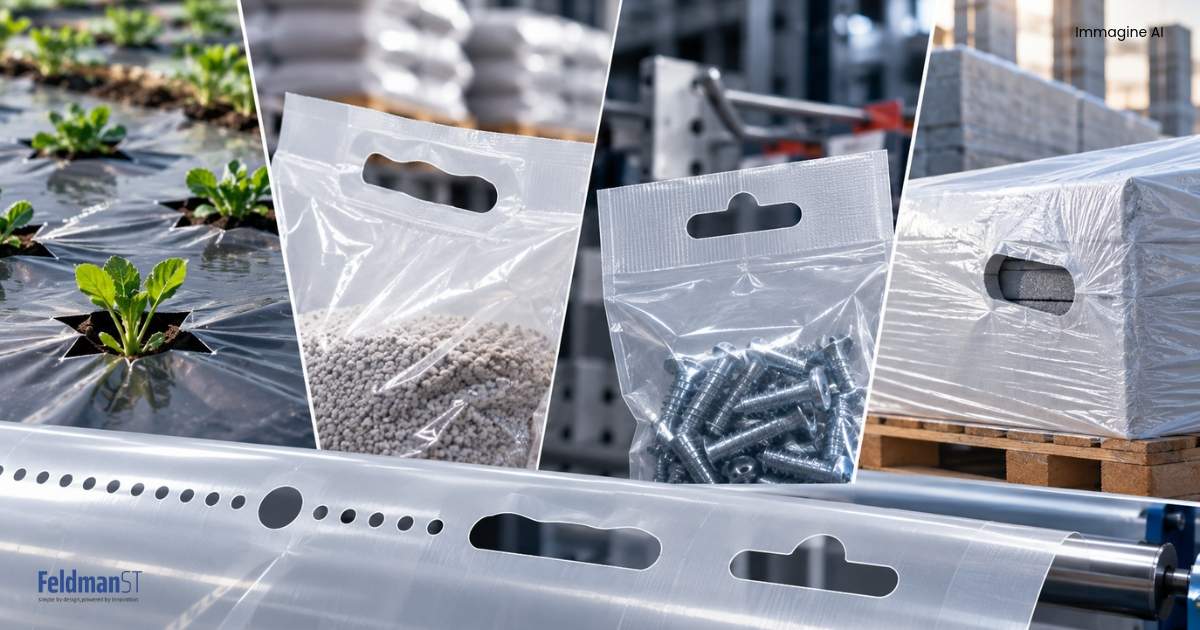
Shaped holes in film: a guide to non-food industrial applications
When shaped holes in plastic film are mentioned, food packaging is usually the first application that comes to mind: produce bags, counter display packs and hanging bags. Yet many applications come from sectors with little connection to food: agriculture, construction and automotive. Here, the hole rarely serves to let the product breathe. It serves to carry it, hang it, open its packaging or lay the film on the ground. Each function requires a precise geometry, in the right position, repeated consistently over thousands of metres of film. This article looks at the shapes and patterns used in the main non-food markets, how they are designed and which process choices matter when industrial perforation is integrated into a converting line. What shaped holes are and how they differ from round holes A shaped hole is any opening with a non-circular geometry or designed for a specific function. Common examples include handle [...]
September 24, 2026
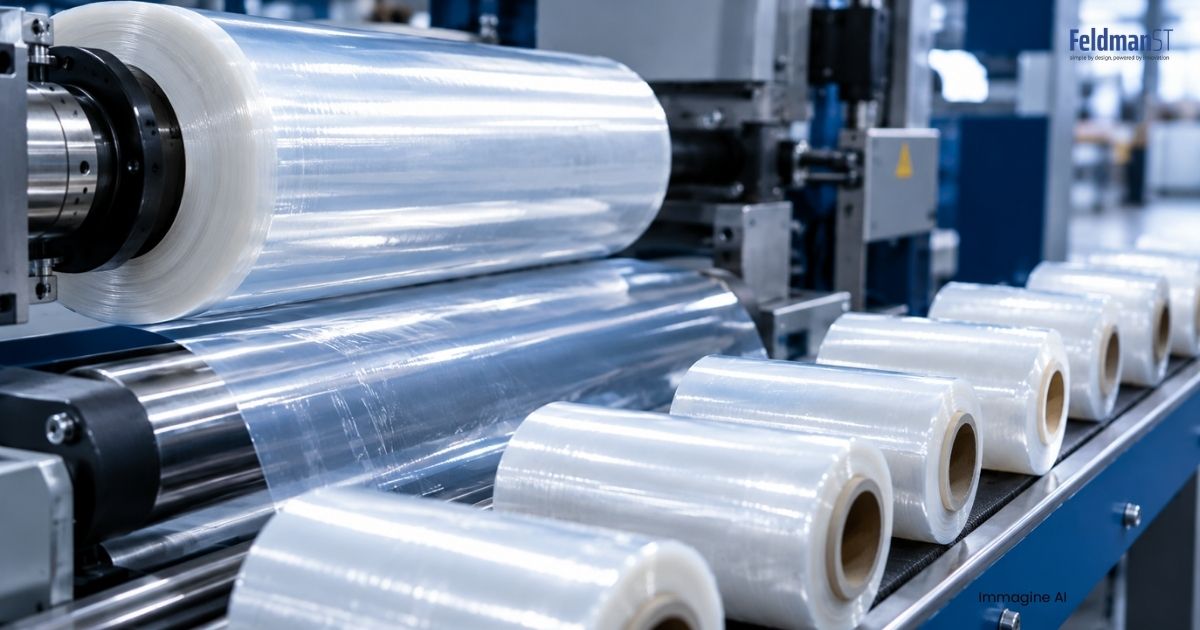
Stretch Film Mini-Roll Production: How to Optimize It
Anyone who handles stretch film mini-roll production for manual use knows: it's not just about rewinding smaller. The compact format — typically between 10 and 12.5 cm in height — brings challenges that don't show up as often on pallet-roll rewinding: irregular opening tails, waste concentrated at roll changes, tension that varies from one core to the next. For production managers, every defect on the mini-roll becomes visible to the end user the moment they try to open it. In this article, we look at the most common problems — tails, waste, breakage — and the technical solutions that optimize cycle time and quality. Why Mini-Rolls Are More Delicate Than Standard Rewinding The mini-roll is a low-height stretch film format — typically between 10 and 12.5 cm — designed for manually wrapping small, loose, or irregularly shaped items. You'll find it in auto repair shops, warehouses, spare parts counters, retail [...]


