
In the current chaos of the plastics market, Feldman ST helps you reduce costs.
Written by: Paola Pireddu
April 9, 2026

In the current chaos of the plastics market, Feldman ST helps you reduce costs.
In an unstable market, the difference is not producing more. It is producing better.
In recent months, the plastics industry has been facing unprecedented pressure.
Volatile raw materials, high energy costs, planning difficulties: every production decision has become more complex.
In this context, many companies are slowing down investments.
But this is exactly where real competitive advantage is created.
Today, those who wait do not win. Those who optimize do.
In plastic film converting – from stretch film to PET, PE and PP – margins depend on a few key elements:
- energy consumption per kg produced
- waste reduction
- process stability
- consistent quality even with variable materials
How we can help
At Feldman ST, we design solutions that address exactly these needs.
Our stretch film rewinders are designed to:
- increase line efficiency
- reduce waste
- ensure precision and production continuity
Our plastic film punching units enable:
- greater control over the finished product
- optimization of film performance
- adaptability to different materials (PE, PP, PET)
The real point is not buying a machine, but reducing the cost per kilo produced.
In today’s market, investing in technology is not a growth choice, but a tool to:
- protect margins
- increase competitiveness
- work in a more stable and predictable way
Looking ahead, even in difficult times.
The companies that choose to optimize their processes today will be the ones leading the market tomorrow.
We are here to help you do it.
Contact us to analyze together how to improve your production performance.
Related News

October 30, 2026
Feldman ST is heading to PLASTIMAGEN 2026 | November 10–13, 2026
🇲🇽 Feldman ST is heading to PLASTIMAGEN 2026! From November 10 to 13, we'll be in Mexico City for one of the leading events for the plastics industry in Latin America. We'll be exhibiting alongside PROINPLAS, our sales partner for South America, at Booth 222! This year, we're bringing our technology directly to the show floor. Visitors will have the opportunity to see one of our perforation units in action, discover how our technology works and discuss solutions for optimizing film converting processes. Together with the PROINPLAS team, we'll be there to share insights, answer technical questions and explore new opportunities. 📍 PLASTIMAGEN 2026 | Mexico City 📅 November 10–13, 2026 📌 Booth 222 | PROINPLAS Come see our perforation technology in action. See you in Mexico City!
October 23, 2026
Shaped holes in film: a guide to non-food industrial applications
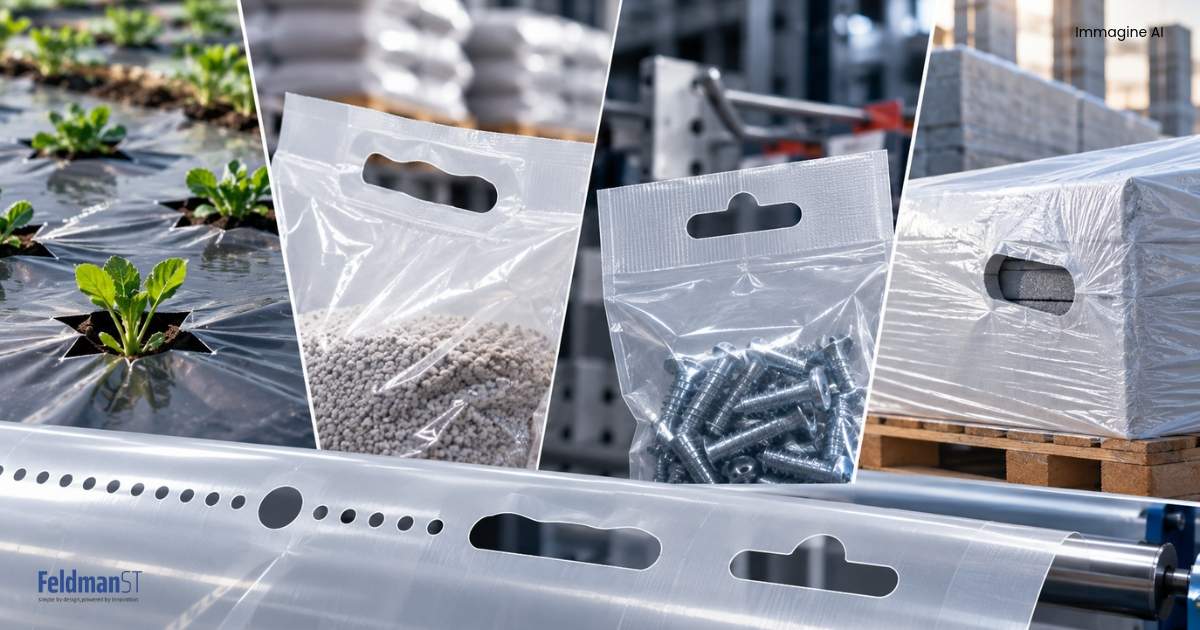
When shaped holes in plastic film are mentioned, food packaging is usually the first application that comes to mind: produce bags, counter display packs and hanging bags. Yet many applications come from sectors with little connection to food: agriculture, construction and automotive. Here, the hole rarely serves to let the product breathe. It serves to carry it, hang it, open its packaging or lay the film on the ground. Each function requires a precise geometry, in the right position, repeated consistently over thousands of metres of film. This article looks at the shapes and patterns used in the main non-food markets, how they are designed and which process choices matter when industrial perforation is integrated into a converting line. What shaped holes are and how they differ from round holes A shaped hole is any opening with a non-circular geometry or designed for a specific function. Common examples include handle [...]
September 24, 2026
Stretch Film Mini-Roll Production: How to Optimize It
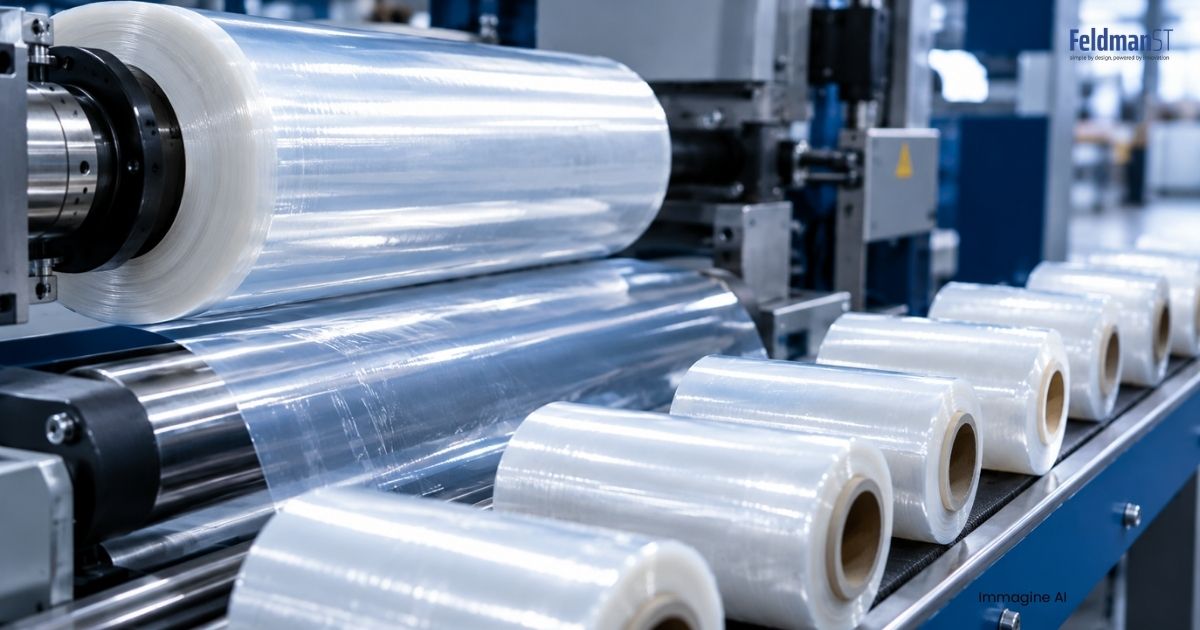
Anyone who handles stretch film mini-roll production for manual use knows: it's not just about rewinding smaller. The compact format — typically between 10 and 12.5 cm in height — brings challenges that don't show up as often on pallet-roll rewinding: irregular opening tails, waste concentrated at roll changes, tension that varies from one core to the next. For production managers, every defect on the mini-roll becomes visible to the end user the moment they try to open it. In this article, we look at the most common problems — tails, waste, breakage — and the technical solutions that optimize cycle time and quality. Why Mini-Rolls Are More Delicate Than Standard Rewinding The mini-roll is a low-height stretch film format — typically between 10 and 12.5 cm — designed for manually wrapping small, loose, or irregularly shaped items. You'll find it in auto repair shops, warehouses, spare parts counters, retail [...]


