
Stretch Hood Perforation: How to Reduce Moisture in Packaging
Written by: Paola Pireddu
August 5, 2026

Stretch hood film protects pallets from dust, rain and weather exposure during transport and storage. But this same airtight seal creates the opposite problem: moisture becomes trapped inside the wrap. Temperature swings between day and night generate condensation on the inner surface of the film. The result is a pallet that, once opened at destination, reveals wet products, moldy bags or compacted materials. Stretch hood perforation solves this trade-off: it creates calibrated micro-openings that let water vapor escape without compromising the mechanical protection of the load. In this article, we look at why condensation forms, how perforation applied to stretch hood film works, and what benefits it brings to those managing industrial packaging lines.
Why Condensation Forms Inside the Elastic Hood
Stretch hood film is designed to be waterproof, blocking water and dust from the outside. But packaged products — fertilizer bags, bricks, food, hygroscopic materials — naturally release water vapor. As the temperature drops, that vapor condenses on the inner side of the film. Water droplets form in direct contact with the product. In months with strong temperature swings, the phenomenon worsens. A pallet stored outdoors, or in a non-climate-controlled warehouse, can accumulate moisture for days even before being shipped.
This creates three direct consequences for production managers:
- Product damage: peeling labels, softened cardboard, caked powders
- Mold risk on organic or food packaging
- Returns and complaints from the end customer
How Perforation Works for Stretch Hood Film Ventilation
Stretch hood perforation introduces very small holes across the film surface, distributed evenly or according to a specific pattern. These holes allow water vapor to escape while still maintaining an effective barrier against rain and dust.
Feldman ST uses micro-hole technology for this type of application: pin, cold or hot perforation, with hole diameters from 0.5 to 2 mm, carried out on the film in motion during production or converting. Hole size, perforation density and layout on the film are calibrated according to the type of packaged product and the level of moisture to be managed.
Perforation Integrated into the Converting Process
Perforation can be inserted directly into the film production line, before rewinding. This eliminates separate processing steps and reduces processing time. For stretch film manufacturers and flexible packaging converters, this means a leaner process, with no isolated production stages.
Which Industries Use Stretch Hood Perforation
Stretch hood perforation is used across several industrial contexts. Fertilizer producers use it to prevent caking in bags stacked on pallets. In building materials, it reduces the risk of efflorescence on bricks and cement bags exposed to temperature swings. In food packaging, it protects dry products and moisture-sensitive packs during prolonged storage. In all these cases, perforation does not replace the mechanical protection of the film: it complements it, managing the water vapor that an unperforated film would otherwise trap inside.
Stretch Hood Perforation: How Much Does It Affect Mechanical Strength?
This is the question production managers ask most often. The answer depends on hole density and size. With calibrated perforation, in most cases the film’s mechanical strength remains sufficient to ensure pallet stability during transport and storage. The pattern should be designed together with the machinery supplier and tested on each type of film and product, to find the right balance between ventilation and protection.
Traditional or Perforated Stretch Hood: Which One to Choose
Traditional stretch hood technology, without perforation, remains suitable for non-hygroscopic products that do not release significant water vapor. For all other cases — fertilizers, bricks, dry foods, moisture-sensitive building materials — perforation reduces the risk of internal condensation. The choice between standard and perforated stretch hood depends on the type of product, storage conditions and transport duration.
Conclusione
Stretch hood perforation makes it possible to maintain the film’s mechanical protection while eliminating the moisture buildup that damages the packaged product. For stretch film manufacturers and flexible packaging converters, integrating this technology into the production line means fewer returns, complaints and rejects. Feldman ST designs micro-hole perforation systems tailored to every type of film and product. Request a technical consultation to evaluate the best solution for your production line.
Related News

October 30, 2026
Feldman ST is heading to PLASTIMAGEN 2026 | November 10–13, 2026
🇲🇽 Feldman ST is heading to PLASTIMAGEN 2026! From November 10 to 13, we'll be in Mexico City for one of the leading events for the plastics industry in Latin America. We'll be exhibiting alongside PROINPLAS, our sales partner for South America, at Booth 222! This year, we're bringing our technology directly to the show floor. Visitors will have the opportunity to see one of our perforation units in action, discover how our technology works and discuss solutions for optimizing film converting processes. Together with the PROINPLAS team, we'll be there to share insights, answer technical questions and explore new opportunities. 📍 PLASTIMAGEN 2026 | Mexico City 📅 November 10–13, 2026 📌 Booth 222 | PROINPLAS Come see our perforation technology in action. See you in Mexico City!
October 23, 2026
Shaped holes in film: a guide to non-food industrial applications
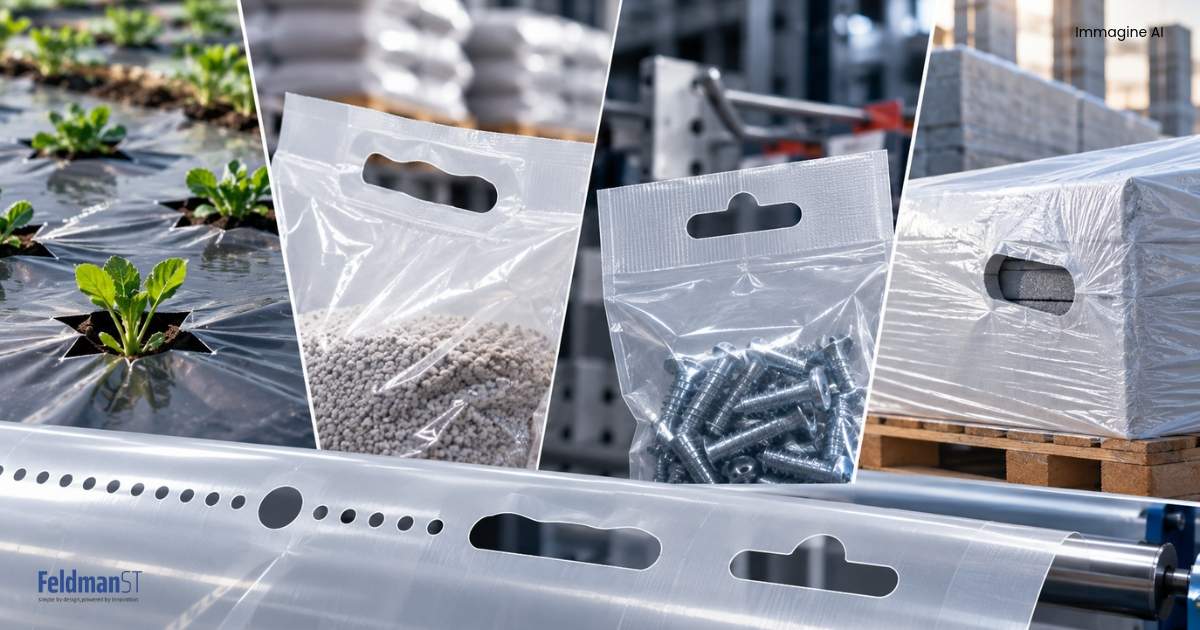
When shaped holes in plastic film are mentioned, food packaging is usually the first application that comes to mind: produce bags, counter display packs and hanging bags. Yet many applications come from sectors with little connection to food: agriculture, construction and automotive. Here, the hole rarely serves to let the product breathe. It serves to carry it, hang it, open its packaging or lay the film on the ground. Each function requires a precise geometry, in the right position, repeated consistently over thousands of metres of film. This article looks at the shapes and patterns used in the main non-food markets, how they are designed and which process choices matter when industrial perforation is integrated into a converting line. What shaped holes are and how they differ from round holes A shaped hole is any opening with a non-circular geometry or designed for a specific function. Common examples include handle [...]
September 24, 2026
Stretch Film Mini-Roll Production: How to Optimize It
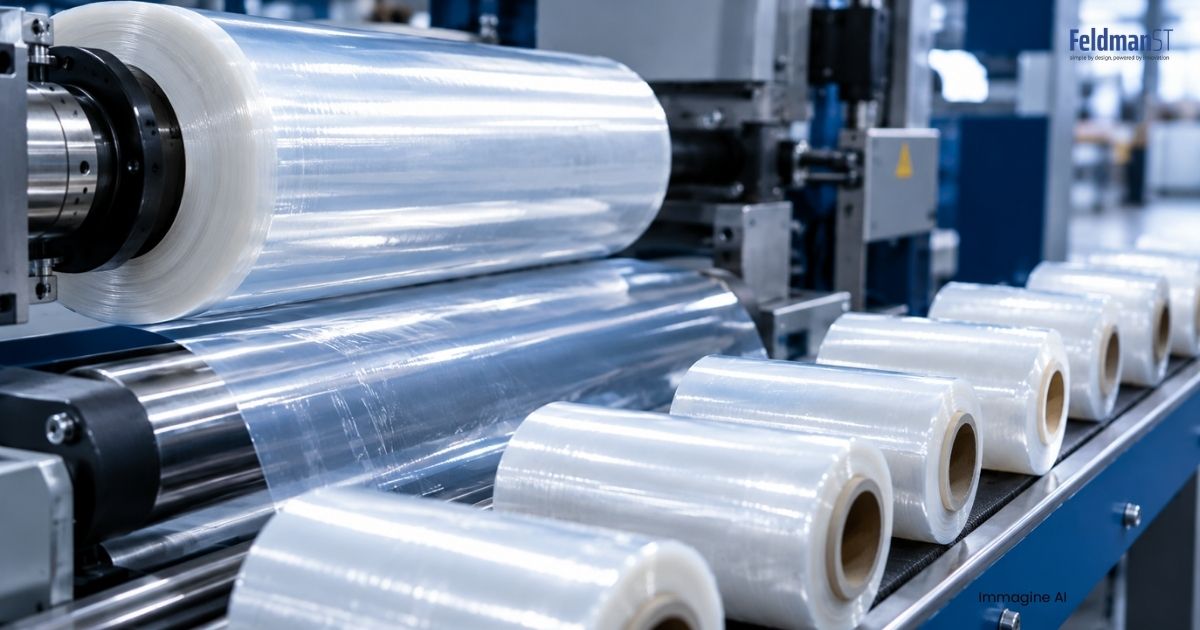
Anyone who handles stretch film mini-roll production for manual use knows: it's not just about rewinding smaller. The compact format — typically between 10 and 12.5 cm in height — brings challenges that don't show up as often on pallet-roll rewinding: irregular opening tails, waste concentrated at roll changes, tension that varies from one core to the next. For production managers, every defect on the mini-roll becomes visible to the end user the moment they try to open it. In this article, we look at the most common problems — tails, waste, breakage — and the technical solutions that optimize cycle time and quality. Why Mini-Rolls Are More Delicate Than Standard Rewinding The mini-roll is a low-height stretch film format — typically between 10 and 12.5 cm — designed for manually wrapping small, loose, or irregularly shaped items. You'll find it in auto repair shops, warehouses, spare parts counters, retail [...]


