
Automation in Flexible Packaging
Written by: Paola Pireddu
August 25, 2026

Watch the complete automated line in action.
Automation in Flexible Packaging: From Individual Machines to an Integrated Production Process.
At PLAST 2026, Feldman ST introduced a clear vision of the future of flexible packaging: automation is no longer simply an optional addition to a production line. It is becoming a fundamental part of the entire converting process.
This concept took shape at our shared booth with Italiana Robot, where visitors could see how different technologies can work together as one coordinated system.
The complete line presented at the exhibition integrated stretch film rewinding, roll handling, box preparation and robotic palletising into a continuous automated production flow—from the jumbo roll to the finished pallet.
Why Automation in Flexible Packaging
Flexible packaging manufacturers are facing increasingly complex production challenges: higher output requirements, shorter delivery times, frequent format changes and growing pressure to reduce costs and waste.
Installing a fast machine is no longer enough if the operations before and after it still depend on manual handling or disconnected processes.
True efficiency comes from considering the production line as a whole.
Automation makes it possible to connect each stage of the process, reducing interruptions and ensuring a smooth, controlled flow of materials and information. Repetitive operations can be managed automatically, while operators can focus on supervision, quality control and higher-value tasks.
The result is not only greater productivity, but also a more stable and predictable production environment.
From the Jumbo Roll to the Finished Pallet
The solution presented at PLAST showed exactly what integrated automation can achieve.
The process begins with the conversion of the jumbo roll into finished stretch film rolls. The rolls are then handled and packed automatically, and the completed boxes are transferred to a robotic palletising system.
Each stage communicates with the next. Products are moved, organised and palletised without unnecessary manual intervention.
This integration provides several concrete advantages:
- Reduced manual handling and lower operator dependency
- More consistent production quality
- Improved workplace safety
- Faster and more controlled production flows
- Reduced downtime between individual operations
- Greater repeatability across different shifts
- Easier production planning and scalability
Automation does not simply mean adding a robot at the end of a line. It means designing machines, handling systems and software to operate as one complete process.
Technology Designed Around the Production Process
Every converter has different requirements. Available space, production volumes, roll formats, packaging methods and logistics all influence the design of an automated line.
For this reason, effective automation cannot be based on a rigid, standard configuration. It must be developed around the customer’s actual production process.
The collaboration between Feldman ST and Italiana Robot combines specialised converting technology with advanced robotic handling and palletising. This approach allows us to develop integrated solutions that connect production, packaging and end-of-line operations according to each customer’s needs.
Automation as a Long-Term Investment
The value of automation goes far beyond production speed.
A well-designed automated line helps companies use their workforce more effectively, minimise process variations, improve safety and maintain consistent output even when skilled operators are difficult to find.
It also creates a solid foundation for future growth. Production capacity can be increased without multiplying manual operations, while processes become easier to monitor, repeat and optimise.
The message we introduced at PLAST remains central to our development strategy: the future of flexible packaging will not be defined by individual machines working faster, but by complete systems working better together.
At Feldman ST, together with our technology partners, we are turning that vision into practical, reliable and customised automation solutions.
Are you considering automating your flexible packaging production process?
Contact us to discuss your application and discover how we can develop a solution around your production requirements.
Related News

October 30, 2026
Feldman ST is heading to PLASTIMAGEN 2026 | November 10–13, 2026
🇲🇽 Feldman ST is heading to PLASTIMAGEN 2026! From November 10 to 13, we'll be in Mexico City for one of the leading events for the plastics industry in Latin America. We'll be exhibiting alongside PROINPLAS, our sales partner for South America, at Booth 222! This year, we're bringing our technology directly to the show floor. Visitors will have the opportunity to see one of our perforation units in action, discover how our technology works and discuss solutions for optimizing film converting processes. Together with the PROINPLAS team, we'll be there to share insights, answer technical questions and explore new opportunities. 📍 PLASTIMAGEN 2026 | Mexico City 📅 November 10–13, 2026 📌 Booth 222 | PROINPLAS Come see our perforation technology in action. See you in Mexico City!
October 23, 2026
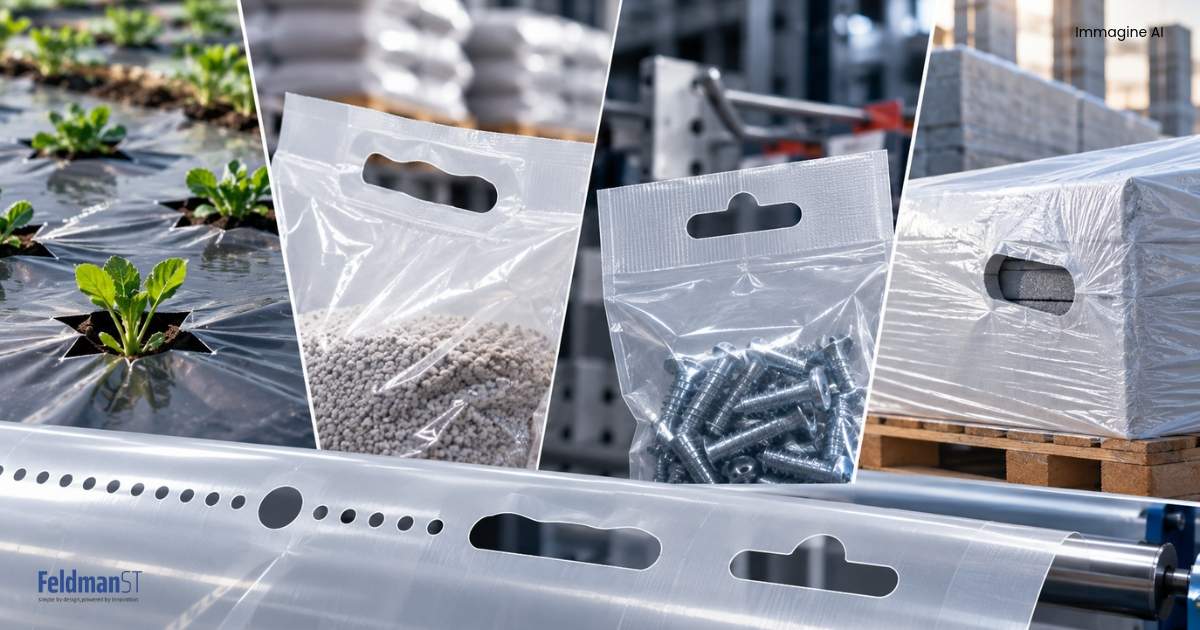
Shaped holes in film: a guide to non-food industrial applications
When shaped holes in plastic film are mentioned, food packaging is usually the first application that comes to mind: produce bags, counter display packs and hanging bags. Yet many applications come from sectors with little connection to food: agriculture, construction and automotive. Here, the hole rarely serves to let the product breathe. It serves to carry it, hang it, open its packaging or lay the film on the ground. Each function requires a precise geometry, in the right position, repeated consistently over thousands of metres of film. This article looks at the shapes and patterns used in the main non-food markets, how they are designed and which process choices matter when industrial perforation is integrated into a converting line. What shaped holes are and how they differ from round holes A shaped hole is any opening with a non-circular geometry or designed for a specific function. Common examples include handle [...]
September 24, 2026
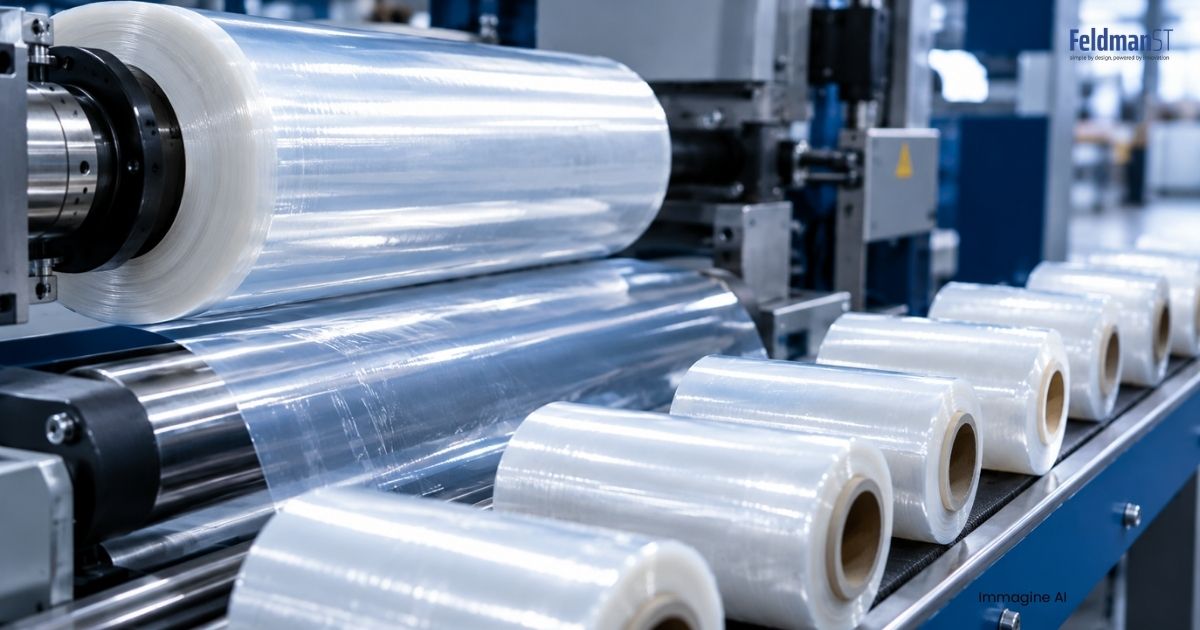
Stretch Film Mini-Roll Production: How to Optimize It
Anyone who handles stretch film mini-roll production for manual use knows: it's not just about rewinding smaller. The compact format — typically between 10 and 12.5 cm in height — brings challenges that don't show up as often on pallet-roll rewinding: irregular opening tails, waste concentrated at roll changes, tension that varies from one core to the next. For production managers, every defect on the mini-roll becomes visible to the end user the moment they try to open it. In this article, we look at the most common problems — tails, waste, breakage — and the technical solutions that optimize cycle time and quality. Why Mini-Rolls Are More Delicate Than Standard Rewinding The mini-roll is a low-height stretch film format — typically between 10 and 12.5 cm — designed for manually wrapping small, loose, or irregularly shaped items. You'll find it in auto repair shops, warehouses, spare parts counters, retail [...]


