
Feldman ST is heading to PLASTIMAGEN 2026 | November 10–13, 2026
Written by: Paola Pireddu
October 30, 2026

🇲🇽 Feldman ST is heading to PLASTIMAGEN 2026!
From November 10 to 13, we’ll be in Mexico City for one of the leading events for the plastics industry in Latin America.
We’ll be exhibiting alongside PROINPLAS, our sales partner for South America, at Booth 222!
This year, we’re bringing our technology directly to the show floor.
Visitors will have the opportunity to see one of our perforation units in action, discover how our technology works and discuss solutions for optimizing film converting processes.
Together with the PROINPLAS team, we’ll be there to share insights, answer technical questions and explore new opportunities.
📍 PLASTIMAGEN 2026 | Mexico City
📅 November 10–13, 2026
📌 Booth 222 | PROINPLAS
Come see our perforation technology in action.
See you in Mexico City!
Related News
October 23, 2026
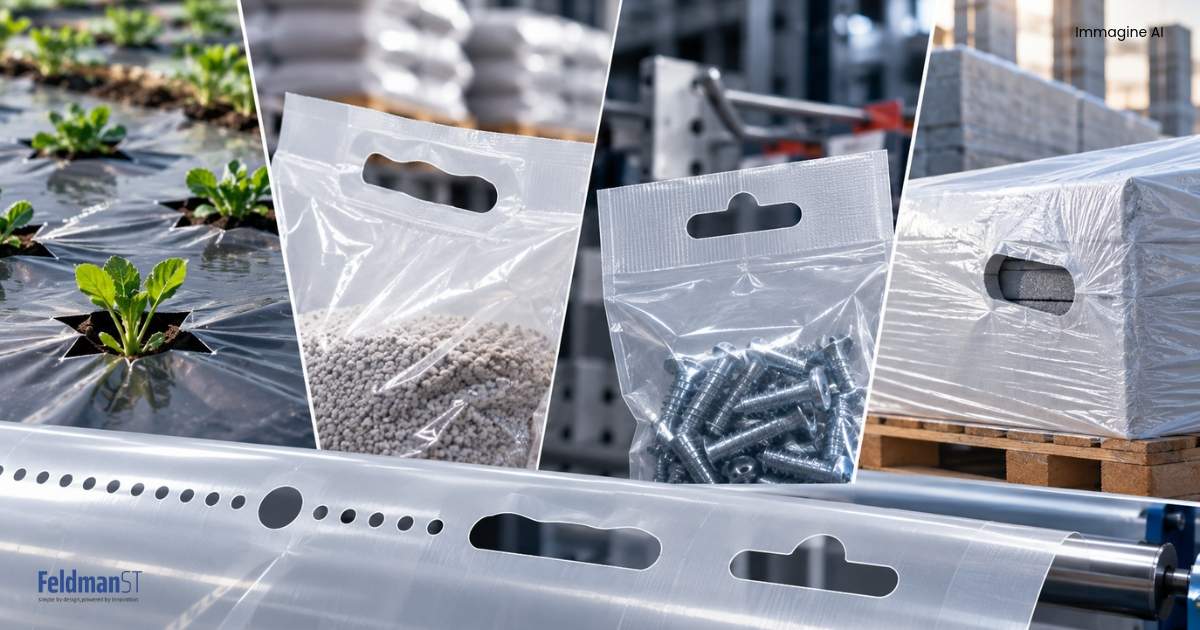
Shaped holes in film: a guide to non-food industrial applications
When shaped holes in plastic film are mentioned, food packaging is usually the first application that comes to mind: produce bags, counter display packs and hanging bags. Yet many applications come from sectors with little connection to food: agriculture, construction and automotive. Here, the hole rarely serves to let the product breathe. It serves to carry it, hang it, open its packaging or lay the film on the ground. Each function requires a precise geometry, in the right position, repeated consistently over thousands of metres of film. This article looks at the shapes and patterns used in the main non-food markets, how they are designed and which process choices matter when industrial perforation is integrated into a converting line. What shaped holes are and how they differ from round holes A shaped hole is any opening with a non-circular geometry or designed for a specific function. Common examples include handle [...]
September 24, 2026
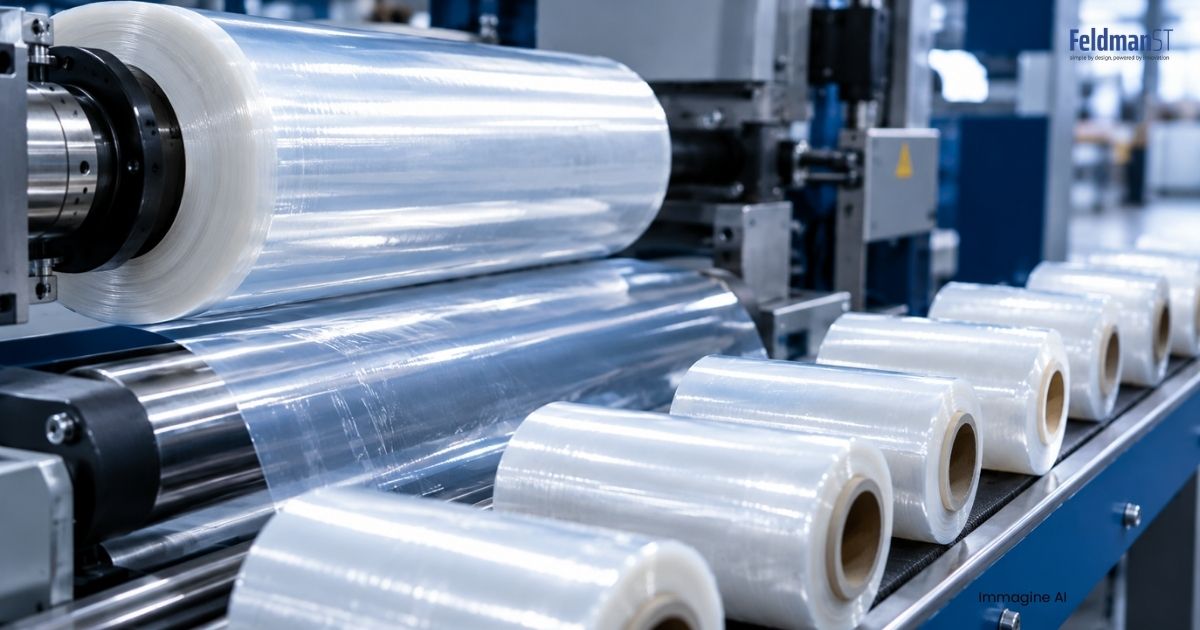
Stretch Film Mini-Roll Production: How to Optimize It
Anyone who handles stretch film mini-roll production for manual use knows: it's not just about rewinding smaller. The compact format — typically between 10 and 12.5 cm in height — brings challenges that don't show up as often on pallet-roll rewinding: irregular opening tails, waste concentrated at roll changes, tension that varies from one core to the next. For production managers, every defect on the mini-roll becomes visible to the end user the moment they try to open it. In this article, we look at the most common problems — tails, waste, breakage — and the technical solutions that optimize cycle time and quality. Why Mini-Rolls Are More Delicate Than Standard Rewinding The mini-roll is a low-height stretch film format — typically between 10 and 12.5 cm — designed for manually wrapping small, loose, or irregularly shaped items. You'll find it in auto repair shops, warehouses, spare parts counters, retail [...]

September 7, 2026
Laser Scoring vs Mechanical Pre-Cutting for Easy-Open
An easy-open system that doesn't open where it should — or opens on its own during transport — is a defect the end customer notices immediately. For flexible film producers, the choice between laser scoring and mechanical pre-cutting for easy-open isn't just a production process decision: it directly affects pack seal integrity, scrap rate, and maintenance costs. The two technologies aren't interchangeable without trade-offs. In this article we compare both methods on precision, repeatability, and impact on the production line, to help you understand which one best fits your film and your production volume. What is easy-open, and why does the technology you choose matter? Easy-open is a controlled weakening line on the film, calibrated to allow manual opening without compromising pack seal integrity until the moment of use. The critical balance is between two opposing requirements: the line has to be deep enough to tear easily, but not so [...]


