
Stretch Film Mini-Roll Production: How to Optimize It
Written by: Paola Pireddu
September 24, 2026
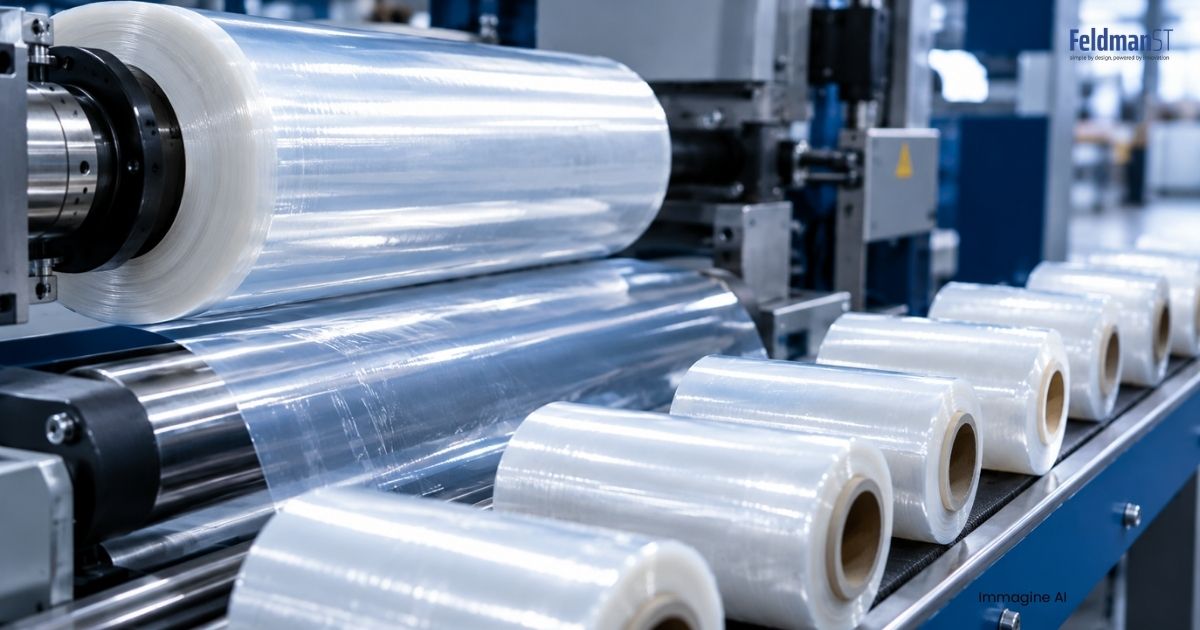
Anyone who handles stretch film mini-roll production for manual use knows: it’s not just about rewinding smaller. The compact format — typically between 10 and 12.5 cm in height — brings challenges that don’t show up as often on pallet-roll rewinding: irregular opening tails, waste concentrated at roll changes, tension that varies from one core to the next. For production managers, every defect on the mini-roll becomes visible to the end user the moment they try to open it. In this article, we look at the most common problems — tails, waste, breakage — and the technical solutions that optimize cycle time and quality.
Why Mini-Rolls Are More Delicate Than Standard Rewinding
The mini-roll is a low-height stretch film format — typically between 10 and 12.5 cm — designed for manually wrapping small, loose, or irregularly shaped items. You’ll find it in auto repair shops, warehouses, spare parts counters, retail environments: anywhere an object needs to be quickly wrapped without using a pallet wrapper.
Compared to pallet-roll rewinding, stretch film mini-roll production imposes three additional constraints: more frequent format changes for the same length of parent film processed; a visible finish, since the roll is handled directly by the operator or the end customer; and tighter tension tolerances, since the inner cores are often thinner than those used for standard rolls.
The Most Common Problems in Stretch Film Mini-Roll Production
Missing or Irregular Opening Tail
The tail is the flap of film the user needs to find to start unwinding the roll. On a pallet roll, this is a minor issue: the operator works with a large format, often using a mechanical dispenser. On a mini-roll handled by hand, a tail that sticks to the roll underneath or tears unevenly is a defect that’s immediately noticed — and it’s one of the most common causes of returns or commercial complaints.
Waste Concentrated at Roll Changes
A mini-roll is a short format: for the same length of parent film processed, the number of core changes increases compared to a standard roll. If the change isn’t fast, the start- and end-of-cycle waste — which barely registers on a pallet roll — multiplies across the number of cycles and becomes a significant cost item at high volumes.
Inconsistent Tension and Breakage During Unwinding
Frequently changing core diameter and type requires re-adjusting tension on every cycle. With a single drive motor, tension tends to vary from one core to the next: the film stretches unevenly or, in the worst cases, breaks during unwinding.
What Signs Indicate That the Mini-Roll Rewinding Cycle Isn’t Optimized?
The most common ones are: recurring complaints about the opening tail, waste per roll above the department average, and frequent machine stoppages due to film breakage during format changes.
How to Optimize the Mini-Roll Production Cycle
Independent Motors for Unwinding and Rewinding
A system with separate motors on the unwind and rewind shafts allows tension to be adjusted independently for each film type and core diameter. It’s the most direct solution to inconsistent tensioning, especially when working with thin cores or multiple film grades on the same line.
Fast Roll Changes with Multi-Spindle Systems
Rewinding systems with multiple spindles, in a turret configuration, allow the cycle to start on a new core while the previous roll is still being completed, without stopping the line. The direct result is less start- and end-of-cycle waste, and a lower cycle time for the same volume produced. This is the configuration used on the Model PRO rewinder, which will be running live during the October Open House.
Automatic Tail Finishing
Lines that handle the closure of the final flap automatically, without manual intervention using tape or cardboard, produce a more uniform tail that’s easier for the end user to find — directly reducing the most noticeable defect described above.
A technical data point: multi-spindle rewinding systems applied to mini-roll production can reach up to 1,600 meters per minute of mechanical speed, with a significant reduction in cycle times compared to a single-spindle configuration.
When It Makes Sense to Automate the Entire Process
At higher volumes, it’s worth considering lines that manage the entire cycle autonomously: core loading, rewinding, cutting, and tail finishing, with manual intervention limited to periodic checks. This choice is justified when the number of daily format changes is high, and the waste per change — even a small amount — adds up across significant volumes.
Stretch film mini-roll production isn’t just a scaled-down version of standard rewinding: frequent changes, variable tension, and a visible finish call for dedicated process control. Optimizing tension, roll-change speed, and tail finishing reduces waste, returns, and machine downtime.
Want to assess which rewinding configuration best fits your volumes and formats? Feldman ST rewinding systems cover the production of both mini-rolls and hand rolls. Contact Feldman ST for a technical consultation on your process.
Anyone who wants to evaluate a solution like this without stopping at the datasheet can also see it live: on October 21-22, Feldman ST opens its Invorio facility with an automatic line running on real volumes, including the option to test your own film. Book your visit to the Open House.
Related News
October 23, 2026
Shaped holes in film: a guide to non-food industrial applications
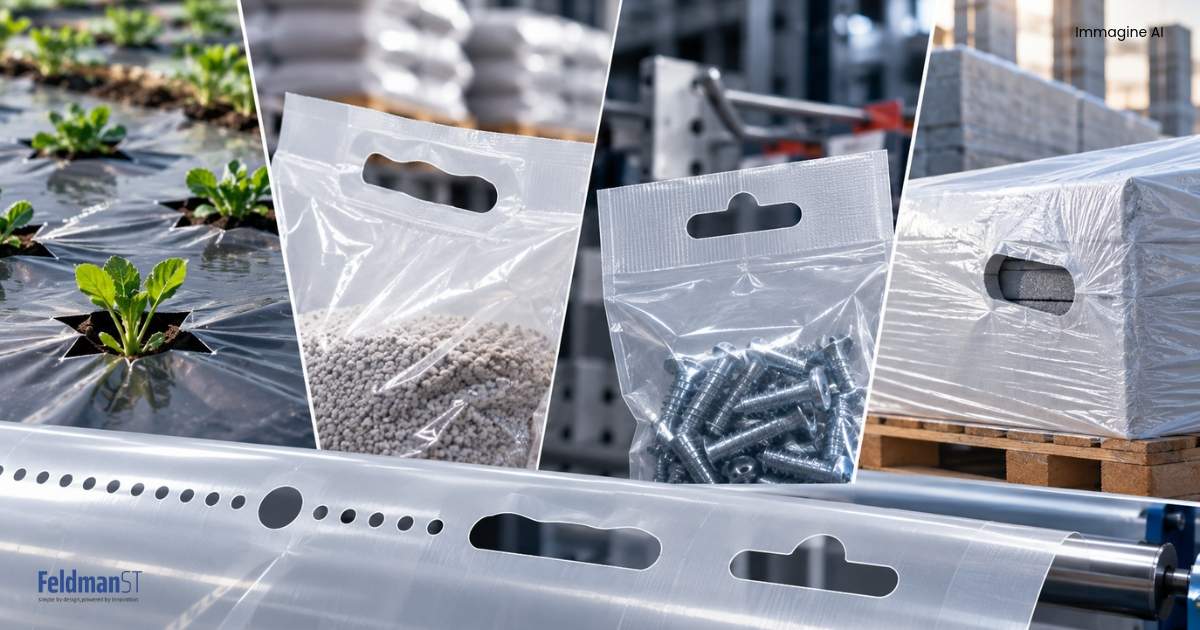
When shaped holes in plastic film are mentioned, food packaging is usually the first application that comes to mind: produce bags, counter display packs and hanging bags. Yet many applications come from sectors with little connection to food: agriculture, construction and automotive. Here, the hole rarely serves to let the product breathe. It serves to carry it, hang it, open its packaging or lay the film on the ground. Each function requires a precise geometry, in the right position, repeated consistently over thousands of metres of film. This article looks at the shapes and patterns used in the main non-food markets, how they are designed and which process choices matter when industrial perforation is integrated into a converting line. What shaped holes are and how they differ from round holes A shaped hole is any opening with a non-circular geometry or designed for a specific function. Common examples include handle [...]

September 7, 2026
Laser Scoring vs Mechanical Pre-Cutting for Easy-Open
An easy-open system that doesn't open where it should — or opens on its own during transport — is a defect the end customer notices immediately. For flexible film producers, the choice between laser scoring and mechanical pre-cutting for easy-open isn't just a production process decision: it directly affects pack seal integrity, scrap rate, and maintenance costs. The two technologies aren't interchangeable without trade-offs. In this article we compare both methods on precision, repeatability, and impact on the production line, to help you understand which one best fits your film and your production volume. What is easy-open, and why does the technology you choose matter? Easy-open is a controlled weakening line on the film, calibrated to allow manual opening without compromising pack seal integrity until the moment of use. The critical balance is between two opposing requirements: the line has to be deep enough to tear easily, but not so [...]

August 25, 2026
Automation in Flexible Packaging
Watch the complete automated line in action. Automation in Flexible Packaging: From Individual Machines to an Integrated Production Process. At PLAST 2026, Feldman ST introduced a clear vision of the future of flexible packaging: automation is no longer simply an optional addition to a production line. It is becoming a fundamental part of the entire converting process. This concept took shape at our shared booth with Italiana Robot, where visitors could see how different technologies can work together as one coordinated system. The complete line presented at the exhibition integrated stretch film rewinding, roll handling, box preparation and robotic palletising into a continuous automated production flow—from the jumbo roll to the finished pallet. Why Automation in Flexible Packaging Flexible packaging manufacturers are facing increasingly complex production challenges: higher output requirements, shorter delivery times, frequent format changes and growing pressure to reduce costs and waste. Installing a fast machine is no [...]


