
Shaped holes in film: a guide to non-food industrial applications
Written by: Paola Pireddu
October 23, 2026
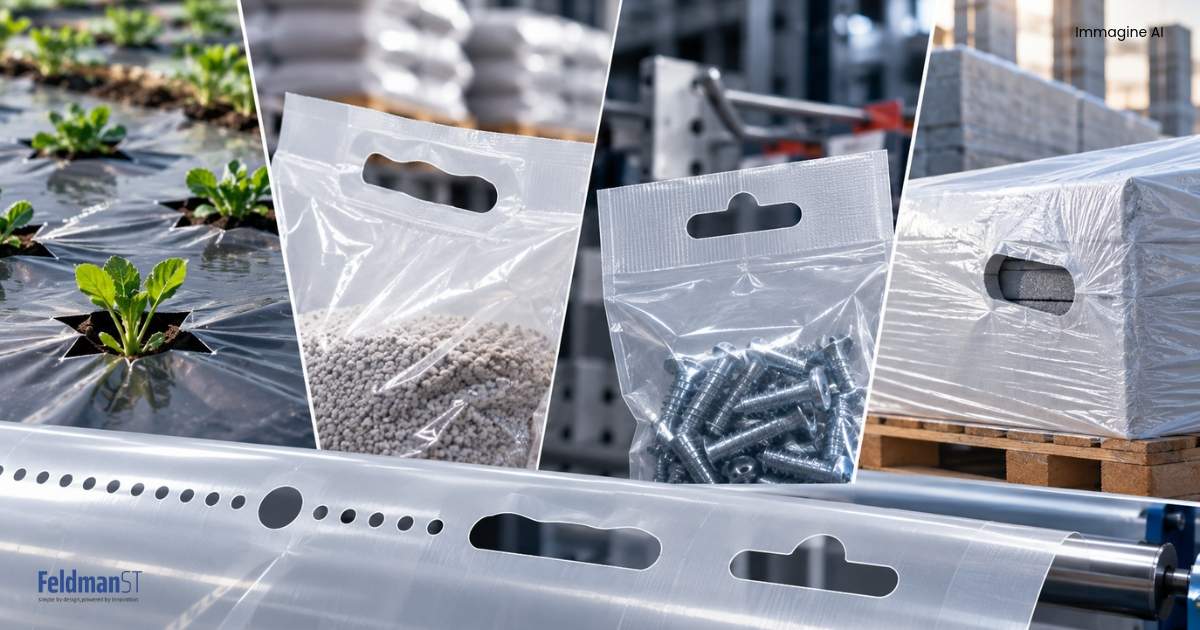
When shaped holes in plastic film are mentioned, food packaging is usually the first application that comes to mind: produce bags, counter display packs and hanging bags. Yet many applications come from sectors with little connection to food: agriculture, construction and automotive.
Here, the hole rarely serves to let the product breathe. It serves to carry it, hang it, open its packaging or lay the film on the ground. Each function requires a precise geometry, in the right position, repeated consistently over thousands of metres of film.
This article looks at the shapes and patterns used in the main non-food markets, how they are designed and which process choices matter when industrial perforation is integrated into a converting line.
What shaped holes are and how they differ from round holes
A shaped hole is any opening with a non-circular geometry or designed for a specific function. Common examples include handle holes, Euro slots for hanging displays, tear notches, elongated slots and custom-designed shapes.
The standard technology is punch-and-die perforation, as used in Feldman ST’s shaped-hole punching systems for film. The punch enters the die with a precision fit, cuts a clean profile and removes the material. The process operates intermittently on stationary film, or on the fly while the film is moving.
Why punch and die? Functional cut-outs typically measure several centimetres and require a clean edge. At this scale, mechanical cutting is faster and more economical than a laser process, which would have to vaporise too much material to achieve competitive cycle times.
What is the difference between a shaped hole and a round hole? A round hole controls a flow: air, vapour or water. A shaped hole enables an interaction: a hand gripping, a hook supporting, a finger opening or a seedling passing through the film. This makes shape the primary functional specification, rather than an aesthetic detail.
Agriculture: mulch films and bags for garden products
Pre-perforated mulch film
Pre-perforated mulch film arrives in the field with the planting holes already in place. The pattern follows the crop’s planting layout: number of rows, spacing between rows and pitch between successive holes in the machine direction. Unperforated strips remain along the sides so that the film edges can be buried.
Alongside round holes, some applications use shaped cuts, such as crosses or stars. These leave a smaller opening around the stem and limit weed emergence.
The critical parameter is pitch repeatability over very long rolls. A small deviation at each hole, accumulated over the entire roll, can cause the row to fall out of alignment with the transplanter. Perforation must therefore remain synchronised with film advance from the beginning to the end of the roll.
Bags for seeds, fertilisers and potting soils
Three geometries recur in formats intended for garden centres and agricultural suppliers:
- handle holes, for carrying a full bag by hand;
- Euro slots, for small bags displayed on hooks;
- tear notches, for opening the pack without tools.
On heavy bags, the handle is load-bearing. Its geometry must be designed together with the film thickness and seal position. On smaller bags, the Euro slot must sit in an area clear of printed graphics and far enough from the edge to prevent tearing when the bag is removed from the hook.
Construction: heavy bags and bundles for manual handling
PE bags for aggregates and construction materials
Sand, decorative gravel, premixed construction products and rubble are heavy materials handled manually on site or at the point of sale. The handle hole is the dominant geometry.
Here, shape matters more than size. Elongated profiles with generous corner radii distribute the load. Sharp corners concentrate stresses and become the starting point for a tear.
Ventilation is a separate issue. To release air from powders during filling, micro-perforation is used, with holes from 0.5 to 2 mm. Both processes can be applied to the same film.
Does a handle hole weaken the bag?
Yes, if it is poorly designed. Every hole removes material from the area that supports the weight. A well-designed handle compensates for this in three ways: generous radii, adequate clearance from the top seal and film thickness suited to the load. The pattern must still be tested on a full bag under actual lifting conditions.
Shrink-wrapped insulation panel bundles
Polystyrene or mineral wool panels are often transported in shrink-film bundles. In some formats, the film incorporates a handle opening that allows the pack to be lifted without cutting the wrapping. Its position must account for shrinkage: the opening must remain functional after passing through the shrink tunnel.
Automotive: tyre storage and spare parts
Tyre bags
Tyre fitters and seasonal storage centres use PE bags to protect and handle tyres. A handle hole near the open end allows the tyre to be carried without touching it. The pattern repeats at each bag length, in register with the bottom seal.
Bag formats vary with rim diameter and tyre width. The same machine may therefore run different bag lengths, and the handle position must adapt to each format.
Bags for spare parts and wall displays
In the spare parts market, many small items are packaged in display bags. Euro slots allow them to hang from panels and hooks. Tear notches make opening easier at the counter. The same principle applies to technical films such as VCI corrosion-inhibiting films, used to protect metal components during transport and storage.
How to design a shaped-hole pattern
In any sector, an effective pattern starts with five choices:
- Use radiused corners instead of sharp angles, especially where the cut-out is subjected to load.
- Maintain a minimum distance from edges and seals. Use print registration when the hole must fall at a precise point in the artwork.
- The distance between holes in the machine direction determines the achievable line speed: more closely spaced holes mean a slower line.
- LDPE, LLDPE, HDPE and coextruded films respond differently to cutting. The punch-and-die fit must be validated on the actual film.
- Operating mode. Intermittent or on the fly, depending on how the film advances through the machine.
There is also the punched-out waste, an often overlooked issue. The removed material must be reliably extracted to prevent it from ending up inside the bag or causing stoppages.
Technical overview: punch and die in figures
- Speed: on plastic film, punch-and-die perforation can reach approximately 250 m/min. The actual value depends on hole pitch.
- Size range: Feldman ST’s punch-and-die range produces holes from 3 to 100 mm.
- Operating modes: intermittent (stationary film) or on the fly (moving film).
- Tools: regrindable and reusable over multiple cycles.
Intermittent or on the fly: which mode should you choose?
The choice depends on the machine on which the punching system is installed, not on the shape of the hole.
Intermittent operation is the natural solution for machines that advance the film in steps, such as bag sealing machines. The film stops for sealing and the punch operates at the same time, without slowing the cycle.
On-the-fly operation is used on continuous converting lines, where the film never stops. Here, punching must be synchronised with material speed, maintaining constant pitch and position even as the line accelerates or decelerates.
In both cases, the aim is the same: to integrate shaped holes into the existing process without adding a separate operation.
Technical films and recycled materials: what changes for cutting
In non-food sectors, bags increasingly contain a proportion of recycled material. This supports sustainability goals, but makes the film less homogeneous than virgin polymer: thickness and cutting behaviour can vary from one batch to another.
For industrial perforation, this means one thing: the pattern must be validated on the film that will actually be used in production, not on an ideal sample. A clean punch-and-die cut, with no additional materials introduced, also preserves the recyclability of mono-material film.
Shaped holes and machine downtime: the format changeover challenge
Bag manufacturers serving several markets change formats frequently: a potting soil bag today, a tyre bag tomorrow. Every change in shape requires the tool to be replaced or adjusted, and every intervention takes machine time away from production.
For bag-making machines, Feldman ST has developed the P4 double-drawer punching unit. One unit can be withdrawn for adjustment or setup while the other remains in line and the machine continues producing. Format changeovers are prepared while the machine is running, rather than during a shutdown.
Regrindable tools can also be restored by surface grinding instead of being replaced. At steady production volumes, this reduces the cost per metre over the medium term.
Conclusion
Outside food packaging, shaped holes in plastic film determine how a product is carried, displayed or opened, or how the film is laid. Shape, position and pitch must be designed around the function, selected to suit the machine and validated on the actual film.
Are you developing a new format for agriculture, construction or automotive? Explore Feldman ST’s shaped-hole punching systems or contact Feldman ST for technical advice on your application.
Related News
September 24, 2026
Stretch Film Mini-Roll Production: How to Optimize It
Anyone who handles stretch film mini-roll production for manual use knows: it's not just about rewinding smaller. The compact format — typically between 10 and 12.5 cm in height — brings challenges that don't show up as often on pallet-roll rewinding: irregular opening tails, waste concentrated at roll changes, tension that varies from one core to the next. For production managers, every defect on the mini-roll becomes visible to the end user the moment they try to open it. In this article, we look at the most common problems — tails, waste, breakage — and the technical solutions that optimize cycle time and quality. Why Mini-Rolls Are More Delicate Than Standard Rewinding The mini-roll is a low-height stretch film format — typically between 10 and 12.5 cm — designed for manually wrapping small, loose, or irregularly shaped items. You'll find it in auto repair shops, warehouses, spare parts counters, retail [...]

September 7, 2026
Laser Scoring vs Mechanical Pre-Cutting for Easy-Open
An easy-open system that doesn't open where it should — or opens on its own during transport — is a defect the end customer notices immediately. For flexible film producers, the choice between laser scoring and mechanical pre-cutting for easy-open isn't just a production process decision: it directly affects pack seal integrity, scrap rate, and maintenance costs. The two technologies aren't interchangeable without trade-offs. In this article we compare both methods on precision, repeatability, and impact on the production line, to help you understand which one best fits your film and your production volume. What is easy-open, and why does the technology you choose matter? Easy-open is a controlled weakening line on the film, calibrated to allow manual opening without compromising pack seal integrity until the moment of use. The critical balance is between two opposing requirements: the line has to be deep enough to tear easily, but not so [...]

August 25, 2026
Automation in Flexible Packaging
Watch the complete automated line in action. Automation in Flexible Packaging: From Individual Machines to an Integrated Production Process. At PLAST 2026, Feldman ST introduced a clear vision of the future of flexible packaging: automation is no longer simply an optional addition to a production line. It is becoming a fundamental part of the entire converting process. This concept took shape at our shared booth with Italiana Robot, where visitors could see how different technologies can work together as one coordinated system. The complete line presented at the exhibition integrated stretch film rewinding, roll handling, box preparation and robotic palletising into a continuous automated production flow—from the jumbo roll to the finished pallet. Why Automation in Flexible Packaging Flexible packaging manufacturers are facing increasingly complex production challenges: higher output requirements, shorter delivery times, frequent format changes and growing pressure to reduce costs and waste. Installing a fast machine is no [...]


