
Laser nanoperforation of plastic film: when it’s the right call (and when it isn’t)
Written by: Paola Pireddu
April 30, 2026

Choosing between laser nanoperforation and mechanical punching is rarely a simple decision. It depends on hole diameter, material, production speed, budget and, increasingly, on traceability and sustainability requirements that weren’t even on the radar a few years ago.
This guide lays out the real-world cases where laser wins, where mechanical still makes more sense, and why conflating the two tends to lead to poor investment decisions.
What laser nanoperforation of plastic film actually is
Laser perforation (also known as nano-perforation) uses a focused laser beam to vaporize microscopic portions of material with micron-level precision. No tooling touches the film. The substrate moves inline, holes are created on the fly, and diameters start from 80 µm with tolerances of ±10 µm across the full film width.
What sets it apart from mechanical perforation isn’t just dimensional accuracy. It’s the absence of pressure. There is no force applied to the substrate and, on certain materials, that single fact changes everything.
When laser nanoperforation is the right choice
Below 200 µm, there’s no real mechanical alternative
Under 200 µm in diameter, mechanical perforation stops being reliable. A pin that small wears out too fast and can’t deliver the repeatability that real production volumes demand.
The classic application here is MAP packaging (Modified Atmosphere Packaging, e.g., tray-sealed fresh red meat, coffee bags with one-way valves, snack bags (chips), etc.) for the food industry.Holes of 80 µm, with tight tolerances, regulate gas and moisture transmission to extend shelf life.
Small dimensional variations directly affect how the product behaves in the package. Laser is the only technology that holds those tolerances consistently at scale.
Inline quality control and lot traceability
Modern laser nanoperforation systems come with high-speed cameras (up to 250 frames per second) monitoring hole diameter, shape and spacing on every metre of film produced. Not on sampled metres, but on every single one.
For production managers who need auditable, exportable lot compliance data, this eliminates manual spot checks and the machine downtime that comes with them. If you’ve ever had to stop a line to verify perforation quality on a hand-pulled sample, you know exactly what this means. With inline laser control, that check happens automatically, continuously and it’s fully documented.
Technical films, laminates, and materials that mechanical punching would damage
No pressure, no mechanical stress, controlled localised heat. That combination makes laser nanoperforation the sensible choice for thin films, multilayer laminates, barrier-layer plastics, and recycled or recyclable substrates, all materials that punch-and-pin systems tend to deform or compromise.
It runs on LDPE, HDPE, OPP, PET, and composite films without altering the substrate structure.
When laser nanoperforation is the wrong choice
Above 2 mm, mechanical punching is faster and cheaper
For holes in the 3 mm to 100 mm range, punch-and-die perforation wins on speed, cost, and operational simplicity. Vaporising that volume of material with a laser requires energy and cycle times that simply aren’t competitive.
The same logic holds for the 0.5–2 mm range. Mechanical pin perforation (whether cold or hot) delivers adequate quality at a significantly lower cost per metre in that segment. Sometimes there’s just no reason to over-engineer it.
High-volume runs with standard hole specifications
If your application involves high hole density on standardised formats and dimensional precision isn’t critical below a certain threshold, a high-speed multi-pin system will almost certainly be more cost-efficient.
Not every process needs nano-perforation, and paying for it when you don’t is just waste.
Sustainability: a factor that’s now shaping investment decisions
Compatibility with mono-material and recyclable films has gone from a nice-to-have to a procurement criterion in a lot of categories.
Laser nanoperforation doesn’t alter the film’s chemical structure and introduces no contaminants into the material. The perforated film stays recyclable, which really matters for companies with packaging sustainability commitments and real deadlines attached to them.
Laser or mechanical: the short version
Laser nanoperforation is the right technology when you need small holes (below 200 µm), precise dimensional control, and integrated production traceability. For large holes, high-volume runs on standard specs, mechanical perforation is still the more efficient choice on the quality-to-cost ratio.
There’s no universal answer. The right call depends on what you’re producing, at what tolerances, and what your quality and sustainability targets actually are.
If you’re evaluating which perforation technology best fits your process, the Feldman ST team can analyse your application and help you choose the right configuration. Contact us or explore our laser perforation solutions for a direct comparison on your materials and formats.
Related News

October 30, 2026
Feldman ST is heading to PLASTIMAGEN 2026 | November 10–13, 2026
🇲🇽 Feldman ST is heading to PLASTIMAGEN 2026! From November 10 to 13, we'll be in Mexico City for one of the leading events for the plastics industry in Latin America. We'll be exhibiting alongside PROINPLAS, our sales partner for South America, at Booth 222! This year, we're bringing our technology directly to the show floor. Visitors will have the opportunity to see one of our perforation units in action, discover how our technology works and discuss solutions for optimizing film converting processes. Together with the PROINPLAS team, we'll be there to share insights, answer technical questions and explore new opportunities. 📍 PLASTIMAGEN 2026 | Mexico City 📅 November 10–13, 2026 📌 Booth 222 | PROINPLAS Come see our perforation technology in action. See you in Mexico City!
October 23, 2026
Shaped holes in film: a guide to non-food industrial applications
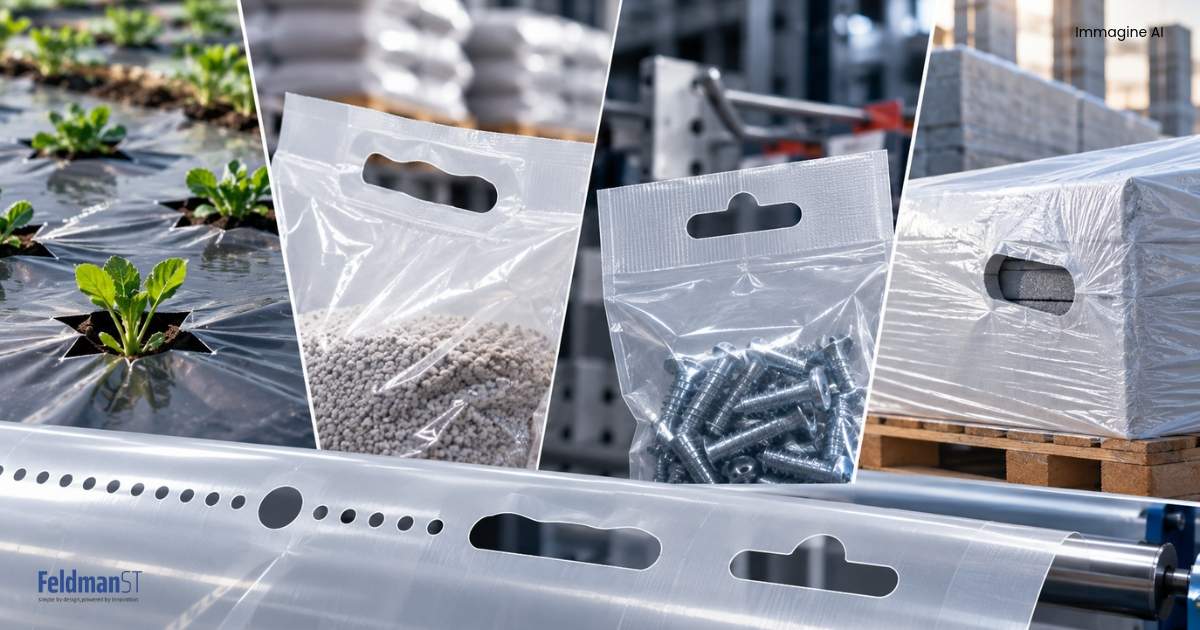
When shaped holes in plastic film are mentioned, food packaging is usually the first application that comes to mind: produce bags, counter display packs and hanging bags. Yet many applications come from sectors with little connection to food: agriculture, construction and automotive. Here, the hole rarely serves to let the product breathe. It serves to carry it, hang it, open its packaging or lay the film on the ground. Each function requires a precise geometry, in the right position, repeated consistently over thousands of metres of film. This article looks at the shapes and patterns used in the main non-food markets, how they are designed and which process choices matter when industrial perforation is integrated into a converting line. What shaped holes are and how they differ from round holes A shaped hole is any opening with a non-circular geometry or designed for a specific function. Common examples include handle [...]
September 24, 2026
Stretch Film Mini-Roll Production: How to Optimize It
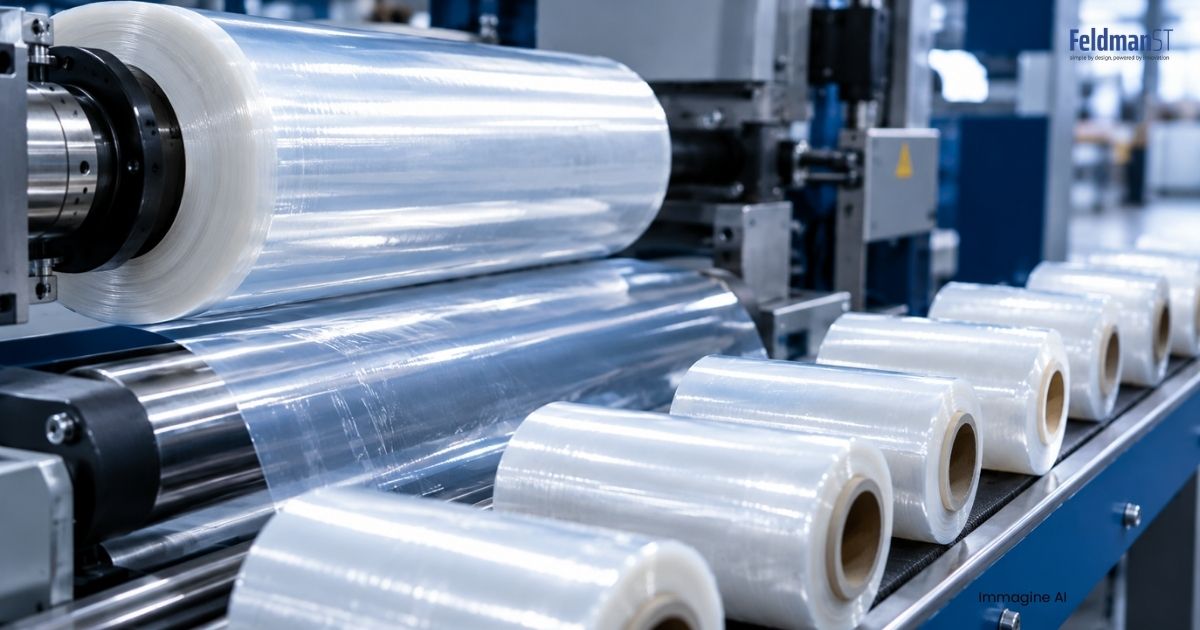
Anyone who handles stretch film mini-roll production for manual use knows: it's not just about rewinding smaller. The compact format — typically between 10 and 12.5 cm in height — brings challenges that don't show up as often on pallet-roll rewinding: irregular opening tails, waste concentrated at roll changes, tension that varies from one core to the next. For production managers, every defect on the mini-roll becomes visible to the end user the moment they try to open it. In this article, we look at the most common problems — tails, waste, breakage — and the technical solutions that optimize cycle time and quality. Why Mini-Rolls Are More Delicate Than Standard Rewinding The mini-roll is a low-height stretch film format — typically between 10 and 12.5 cm — designed for manually wrapping small, loose, or irregularly shaped items. You'll find it in auto repair shops, warehouses, spare parts counters, retail [...]


