
Discover our Printing Machines at DRUPA 2024
Written by: Batya Feldman
April 18, 2024

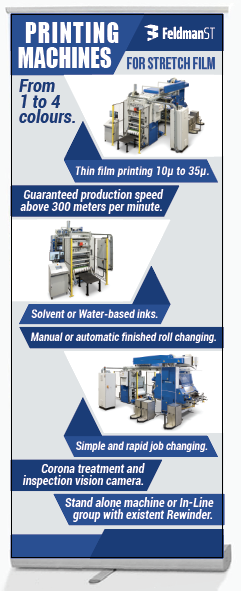
Join Feldman ST at DRUPA 2024, the largest trade fair for the printing and graphics industry worldwide, which will take place in Düsseldorf, in Germany, from May 28 to June 7, 2024, as we will unveil the capabilities of our printing machines for stretch film and adhesive tapes. At our booth, you’ll witness how efficient and profitable these printing machines are, setting new standards in the industry.
The printing machines stand out for several reasons. Firstly, they are the only machines capable of printing on ultra-thin film, starting from just 10 microns. This groundbreaking feature opens up new possibilities for packaging and labeling applications. Additionally, the printers boast unparalleled speed, running at an impressive speed of 375/400 meters per minute without compromising quality.
Feldman ST takes pride in producing the largest printed stretch film globally, thanks to more than 50 printing machines worldwide. The profitability of our printing areas is staggering, with potential profits reaching 20-30 times higher than traditional rewinding processes. The profit margins are exceptionally lucrative, with a low printing material cost of just 0.2 euro/kg compared to a selling price of 0.5-0.6 euro/kg.
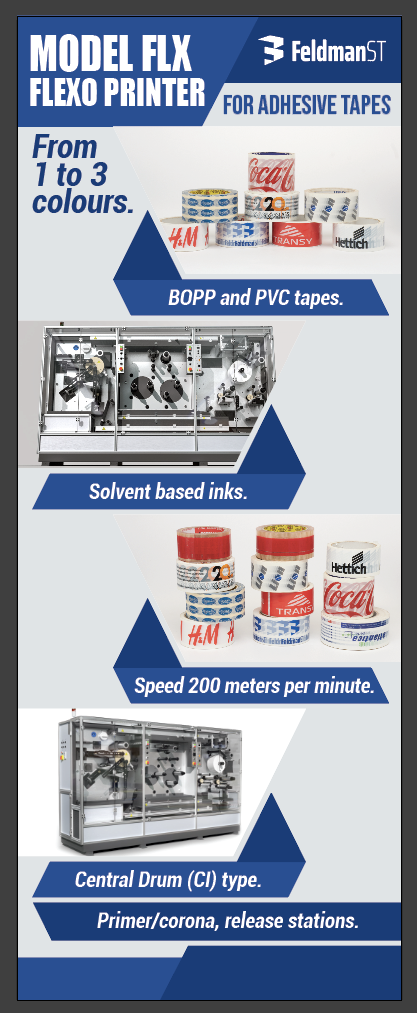
Furthermore, the adhesive tapes printing machine showcases advanced, precise, and efficient printing features. This semi-automatic central impression flexographic machine excels in three-color printing on adhesive tapes, offering cutting and rewinding capabilities in various widths and lengths. Compatible with PVC and BOPP adhesive tape, it operates seamlessly with three printing stations, two additional stations for priming/release, and a sophisticated slitting system.
Visit FST’s booth B60 at HALL 13 to get more information about our printing machines at DRUPA 2024, explore how our innovative printing solutions can revolutionize your production processes and drive profitability in your business.
To book a meeting, please write to us today
Related News

October 30, 2026
Feldman ST is heading to PLASTIMAGEN 2026 | November 10–13, 2026
🇲🇽 Feldman ST is heading to PLASTIMAGEN 2026! From November 10 to 13, we'll be in Mexico City for one of the leading events for the plastics industry in Latin America. We'll be exhibiting alongside PROINPLAS, our sales partner for South America, at Booth 222! This year, we're bringing our technology directly to the show floor. Visitors will have the opportunity to see one of our perforation units in action, discover how our technology works and discuss solutions for optimizing film converting processes. Together with the PROINPLAS team, we'll be there to share insights, answer technical questions and explore new opportunities. 📍 PLASTIMAGEN 2026 | Mexico City 📅 November 10–13, 2026 📌 Booth 222 | PROINPLAS Come see our perforation technology in action. See you in Mexico City!
October 23, 2026
Shaped holes in film: a guide to non-food industrial applications
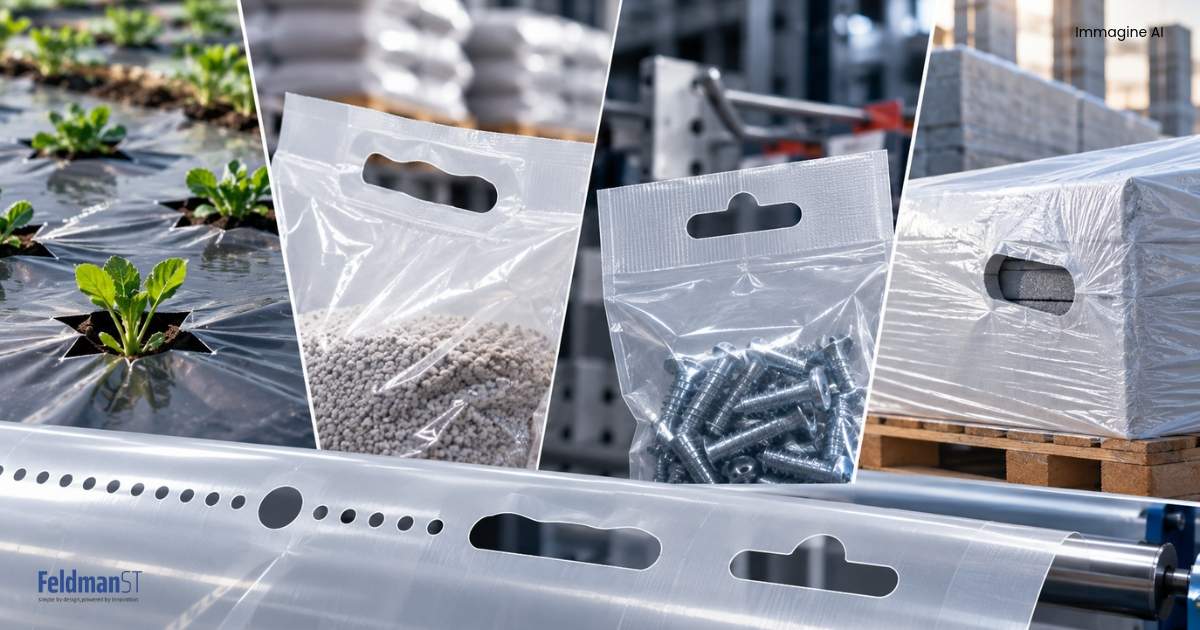
When shaped holes in plastic film are mentioned, food packaging is usually the first application that comes to mind: produce bags, counter display packs and hanging bags. Yet many applications come from sectors with little connection to food: agriculture, construction and automotive. Here, the hole rarely serves to let the product breathe. It serves to carry it, hang it, open its packaging or lay the film on the ground. Each function requires a precise geometry, in the right position, repeated consistently over thousands of metres of film. This article looks at the shapes and patterns used in the main non-food markets, how they are designed and which process choices matter when industrial perforation is integrated into a converting line. What shaped holes are and how they differ from round holes A shaped hole is any opening with a non-circular geometry or designed for a specific function. Common examples include handle [...]
September 24, 2026
Stretch Film Mini-Roll Production: How to Optimize It
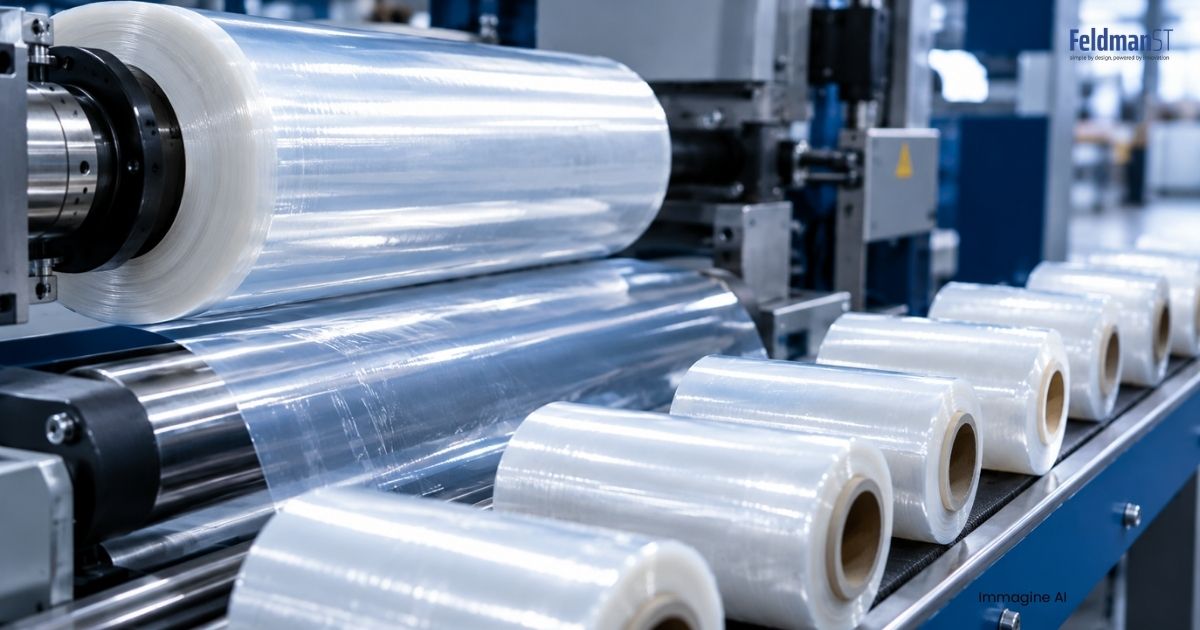
Anyone who handles stretch film mini-roll production for manual use knows: it's not just about rewinding smaller. The compact format — typically between 10 and 12.5 cm in height — brings challenges that don't show up as often on pallet-roll rewinding: irregular opening tails, waste concentrated at roll changes, tension that varies from one core to the next. For production managers, every defect on the mini-roll becomes visible to the end user the moment they try to open it. In this article, we look at the most common problems — tails, waste, breakage — and the technical solutions that optimize cycle time and quality. Why Mini-Rolls Are More Delicate Than Standard Rewinding The mini-roll is a low-height stretch film format — typically between 10 and 12.5 cm — designed for manually wrapping small, loose, or irregularly shaped items. You'll find it in auto repair shops, warehouses, spare parts counters, retail [...]


