
Discover the Innovation in Printing at DRUPA 2024
Written by: Batya Feldman
May 21, 2024

The first DRUPA Fair after eight years will be held from May 28 to June 7, 2024, creating lots of interest. During this period, the printing industry has undergone a remarkable transformation, driven primarily by the shift to digital printing, which enhances efficiency and reduces production costs.
The Revolution in Industrial Printing
Over the past eight years, digital printing technologies have changed the industrial printing market. These advancements have significantly improved printing speed, quality, and cost-efficiency, allowing businesses to stay competitive in a rapidly evolving market. Digital printing not only streamlines production processes but also opens new possibilities for customization and on-demand printing, meeting the diverse needs of modern consumers.
Feldman ST is at the forefront of these industry changes and is proud to showcase our innovative solutions at DRUPA 2024. Visit the relative section on our website to see our printing machines in action. Here’s what makes our machines stand out:
- Ultra-Thin Film Printing: Feldman’s printers are the only ones capable of printing ultra-thin film, starting from just 10 microns. This feature is groundbreaking for packaging and labeling applications, offering new possibilities and greater flexibility.
- Unmatched Speed: Feldman’s machines run at an impressive speed of 375/400 meters per minute, ensuring high productivity without compromising quality.
- Global Reach: Feldman ST boasts the largest printed stretch film production globally, with over 50 printing machines deployed worldwide.
- High Profitability: The profitability of our printing areas is remarkable, with potential profits reaching 20-30 times higher than traditional rewinding processes. The profit margins are exceptionally lucrative, with a low printing material cost of just 0.2 euros per kilogram and a selling price of 0.5-0.6 euros per kilogram.
DRUPA 2024 is your chance to explore the latest advancements and trends in the printing industry. Don’t miss the opportunity to see how Feldman ST’s cutting-edge technology can transform your operations and boost your profitability.
📍 Visit us at booth B60 in HALL 13 or schedule a meeting !
We look forward to seeing you in Düsseldorf!

Related News

October 30, 2026
Feldman ST is heading to PLASTIMAGEN 2026 | November 10–13, 2026
🇲🇽 Feldman ST is heading to PLASTIMAGEN 2026! From November 10 to 13, we'll be in Mexico City for one of the leading events for the plastics industry in Latin America. We'll be exhibiting alongside PROINPLAS, our sales partner for South America, at Booth 222! This year, we're bringing our technology directly to the show floor. Visitors will have the opportunity to see one of our perforation units in action, discover how our technology works and discuss solutions for optimizing film converting processes. Together with the PROINPLAS team, we'll be there to share insights, answer technical questions and explore new opportunities. 📍 PLASTIMAGEN 2026 | Mexico City 📅 November 10–13, 2026 📌 Booth 222 | PROINPLAS Come see our perforation technology in action. See you in Mexico City!
October 23, 2026
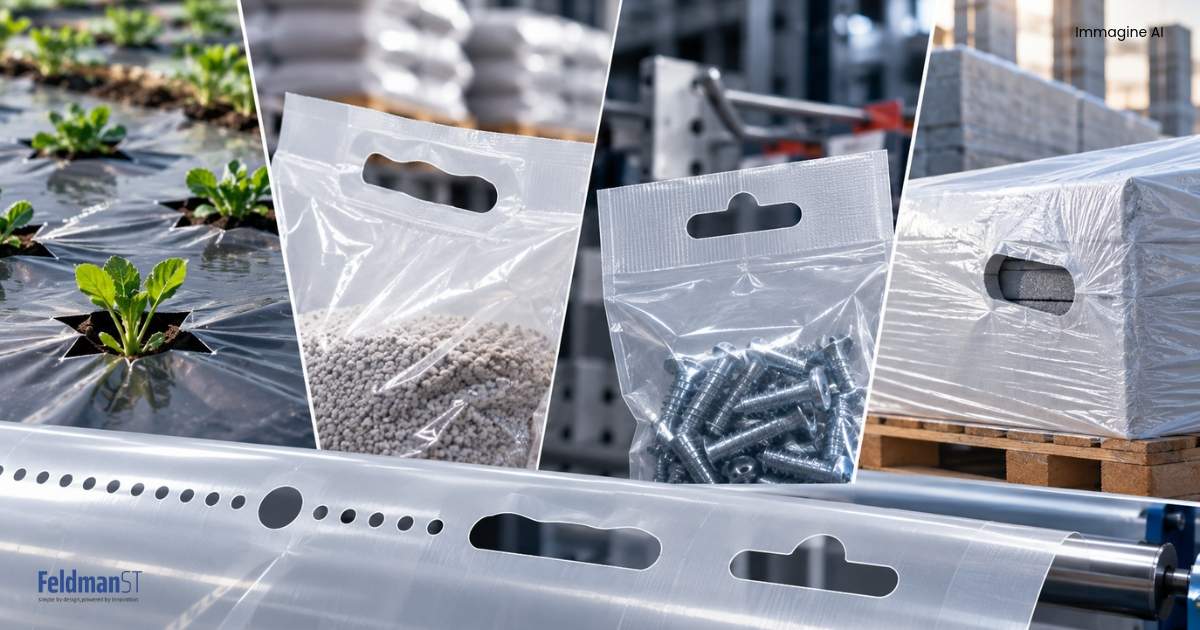
Shaped holes in film: a guide to non-food industrial applications
When shaped holes in plastic film are mentioned, food packaging is usually the first application that comes to mind: produce bags, counter display packs and hanging bags. Yet many applications come from sectors with little connection to food: agriculture, construction and automotive. Here, the hole rarely serves to let the product breathe. It serves to carry it, hang it, open its packaging or lay the film on the ground. Each function requires a precise geometry, in the right position, repeated consistently over thousands of metres of film. This article looks at the shapes and patterns used in the main non-food markets, how they are designed and which process choices matter when industrial perforation is integrated into a converting line. What shaped holes are and how they differ from round holes A shaped hole is any opening with a non-circular geometry or designed for a specific function. Common examples include handle [...]
September 24, 2026
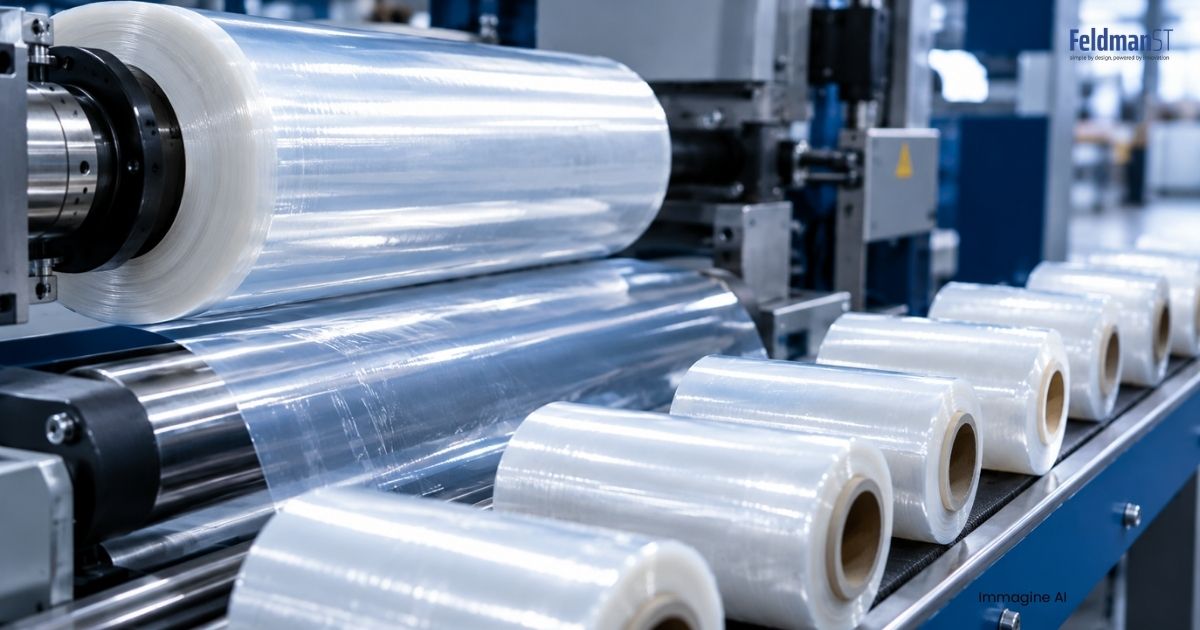
Stretch Film Mini-Roll Production: How to Optimize It
Anyone who handles stretch film mini-roll production for manual use knows: it's not just about rewinding smaller. The compact format — typically between 10 and 12.5 cm in height — brings challenges that don't show up as often on pallet-roll rewinding: irregular opening tails, waste concentrated at roll changes, tension that varies from one core to the next. For production managers, every defect on the mini-roll becomes visible to the end user the moment they try to open it. In this article, we look at the most common problems — tails, waste, breakage — and the technical solutions that optimize cycle time and quality. Why Mini-Rolls Are More Delicate Than Standard Rewinding The mini-roll is a low-height stretch film format — typically between 10 and 12.5 cm — designed for manually wrapping small, loose, or irregularly shaped items. You'll find it in auto repair shops, warehouses, spare parts counters, retail [...]


